In almost every classroom, there are pupils who try hard in mathematics and still feel lost. They listen carefully, follow instructions, and yet numbers never quite stick. Quantities feel slippery, procedures break down halfway, and even familiar tasks require enormous effort. For learners with dyscalculia, this experience goes far beyond a simple dislike of math.
Dyscalculia is a specific learning difficulty that affects number sense, quantity processing, and the ability to manipulate numerical information, even when instruction is clear and well structured (Butterworth, Varma, & Laurillard, 2011). Understanding this reality invites educators to rethink how mathematics is taught, particularly for learners who struggle in abstract or speed-driven environments.
Recognising dyscalculia means changing how we interpret pupils’ difficulties. These learners are not careless, unmotivated, or inattentive. Research shows that their challenges are rooted in how numerical information is represented and accessed cognitively, not in intelligence or effort (Price & Ansari, 2013). Once this perspective is adopted, the pedagogical question shifts. The issue is no longer how to make pupils adapt to mathematics, but how to adapt mathematics to pupils with different ways of thinking.
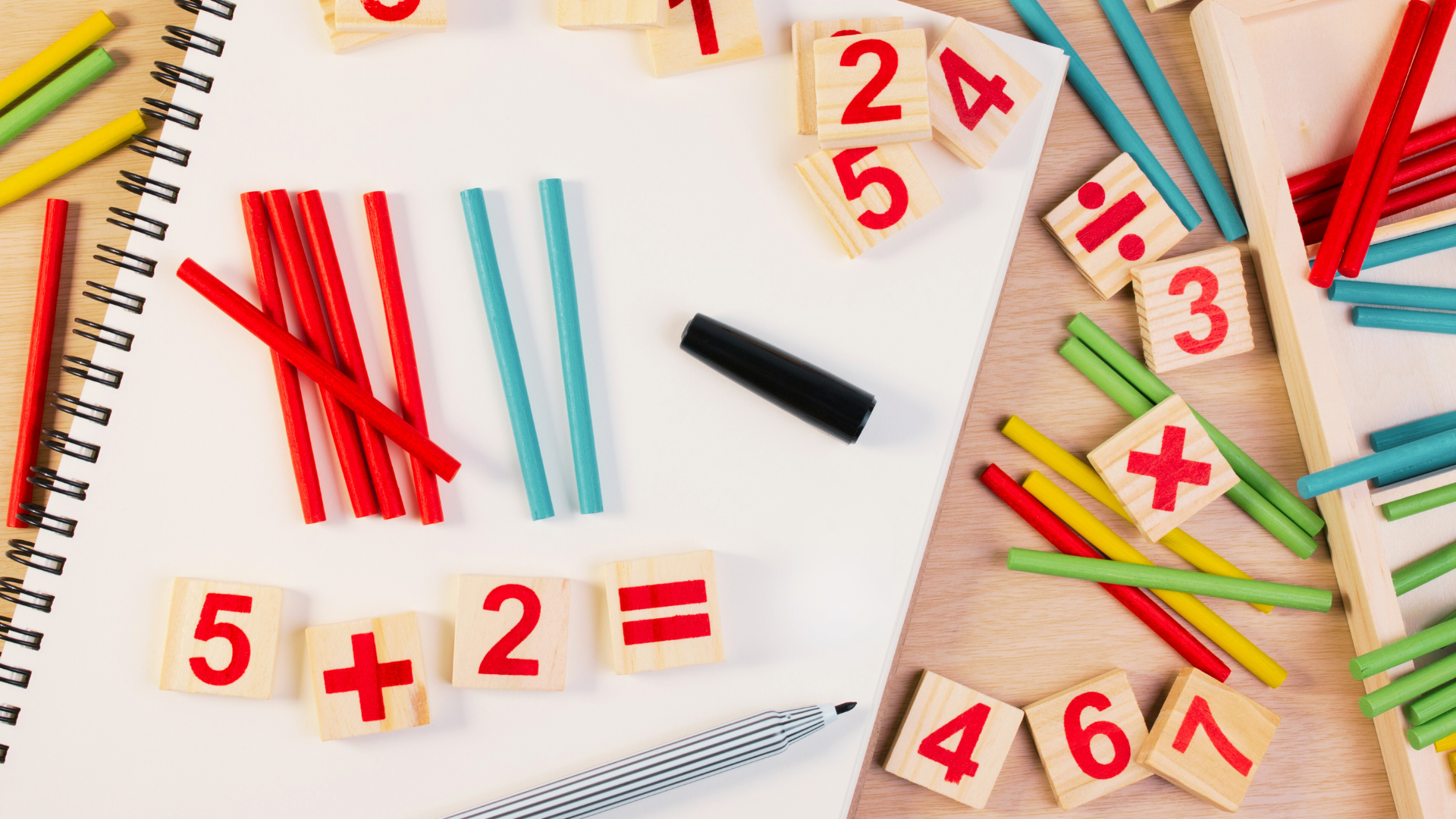
One of the strongest insights from research is that pupils with dyscalculia need more time and more varied experiences to build meaning before abstraction. Mathematical symbols only become useful when they refer to something the learner already understands. Educational psychology consistently supports the use of a concrete–representational–abstract progression, particularly for learners with persistent difficulties (Fyfe et al., 2014). In practice, this progression is rarely linear, and many pupils need to move back and forth between manipulation, visualisation, and symbols over an extended period.
This pedagogical logic is at the heart of the Enigmathico project, a European initiative that designs learning experiences combining storytelling, riddles, manipulation, and collaboration to support mathematical and scientific thinking. Rather than introducing concepts in isolation, Enigmathico structures learning into sequences where pupils explore ideas through meaningful challenges before formalising them. This approach aligns closely with inclusive practices, especially for learners who rely on concrete reference points to stabilise understanding.
Manipulation plays a crucial role here, but it becomes even more effective when combined with play. Place value, for example, is easier to grasp when pupils take part in simple exchange games, trading ten single objects for one “ten” token while playing a board game or managing points in a shared challenge. Through repeated action, “ten ones make one ten” becomes something pupils do, not just something they hear.
Fractions similarly benefit from visual and playful tools. Using fraction circles, strips, or paper “pizzas,” pupils can build, compare, and share parts of a whole in concrete situations such as a classroom shop or a cooking game. Games like fraction dominoes or matching activities help stabilise recognition and comparison without pressure. Research shows that pupils who develop strong visual models of fractions achieve deeper and more lasting understanding than those who work mainly with symbols (Siegler et al., 2013). For learners with dyscalculia, these experiences are not optional supports but the essential pathway through which abstraction later becomes meaningful.
Emotional experience matters just as much as cognitive structure. Many pupils with dyscalculia associate mathematics with repeated failure, anxiety, and loss of confidence. Math anxiety has been shown to interfere directly with working memory and performance, creating a cycle that disproportionately affects vulnerable learners (Ashcraft, 2002; Maloney & Beilock, 2012). In this context, playful and well-designed game-based approaches can offer a powerful counterbalance when they are aligned with clear learning goals.
Games that focus on a single mathematical idea, provide immediate feedback, and allow mistakes without public exposure can transform practice into participation. A simple example is a number-line board game in which pupils roll a die and move a token forward or backward. The outcome of each move is immediately visible, and errors naturally invite adjustment rather than judgement. Rather than being evaluated, pupils are encouraged to try, revise, and try again, creating a sense of emotional safety. This shift is particularly important for learners with dyscalculia, who often disengage when speed and accuracy dominate classroom expectations.
Another key support lies in storytelling and meaningful context. Bare numbers can feel arbitrary, especially for pupils who struggle to retain them. Stories give numbers a role and a reason to exist. As Bruner (1991) argued, narrative is one of the primary ways humans make sense of the world. When mathematical problems are embedded in familiar or imaginable situations, learners can anchor reasoning in meaning rather than memorisation. Narrative contexts also act as memory anchors, supporting recall more effectively than abstract numbers alone (Van den Heuvel-Panhuizen, 2012).
Narrative approaches are particularly helpful for multi-step problems, which place heavy demands on working memory. When each step corresponds to an event in a story, learners can externalise their thinking through drawings, objects, or discussion. The final equation then appears as a concise record of something already understood, rather than as an abstract demand.
Beyond individual strategies, inclusion depends on classroom culture. Pupils with dyscalculia benefit from environments where tools such as number lines, manipulatives, and visual supports are normalised and available to everyone. Removing unnecessary time pressure and valuing explanation over speed further supports learners whose understanding may develop more slowly but just as meaningfully.
Progress for pupils with dyscalculia is often uneven and non-linear. Yet through concrete experiences, emotionally safe practice, and meaningful stories, many develop a functional and sometimes confident relationship with mathematics. Approaches that combine manipulation, collaboration, and playful challenge show that inclusion does not mean simplifying mathematics. It means recognising that understanding grows over time, through experience, and through human connection.
When learning feels like unravelling an enigma worth exploring rather than passing a test, mathematics opens up to everyone. This shared belief continues to guide collaborative work between EGLE and our partners in the Enigmathico project, where gamification is understood not as decoration but as a pathway toward deeper engagement and inclusion.
Do you want to join the adventure and make math accessible to all through play? Follow the project at enigmathico.eu/!
References:
Ashcraft, M. H. (2002). Math anxiety: Personal, educational, and cognitive consequences. Current Directions in Psychological Science, 11(5), 181-185. https://doi.org/10.1111/1467-8721.00196
Bruner, J. S. (1991). The narrative construction of reality. Critical Inquiry, 18(1), 1-21. https://doi.org/10.1086/448619
Butterworth, B., Varma, S., and Laurillard, D. (2011). Dyscalculia: From brain to education. Science, 332(6033), 1049-1053. https://doi.org/10.1126/science.1201536
Fyfe, E. R., McNeil, N. M., Son, J. Y., and Goldstone, R. L. (2014). Concreteness fading in mathematics and science instruction: A systematic review. Educational Psychology Review, 26(1), 9-25. https://doi.org/10.1007/s10648-014-9249-3
Maloney, E. A., and Beilock, S. L. (2012). Math anxiety: Who has it, why it develops, and how to guard against it. Trends in Cognitive Sciences, 16(8), 404-406. https://doi.org/10.1016/j.tics.2012.06.008
Price, G. R., and Ansari, D. (2013). Dyscalculia. In D. Reisberg (Ed.), The Oxford handbook of cognitive psychology (pp. 781-794). Oxford University Press. https://doi.org/10.1093/oxfordhb/9780195376746.013.0050
Siegler, R. S., Thompson, C. A., and Schneider, M. (2013). An integrated theory of whole number and fractions development. Cognitive Psychology, 62(4), 273-296. https://doi.org/10.1016/j.cogpsych.2011.03.001
Van den Heuvel-Panhuizen, M. (2012). The role of contexts in assessment problems in mathematics. ZDM – The International Journal on Mathematics Education, 44(4), 571-582. https://doi.org/10.1007/s11858-012-0408-6